Patient Workflow & the Healthcare Revenue Cycle
Trace the path a patient takes through a healthcare encounter and learn how each step connects to the revenue cycle.
By the end of this lesson you can
- Trace a patient encounter from scheduling through payment
- Identify which zone of the practice owns each step
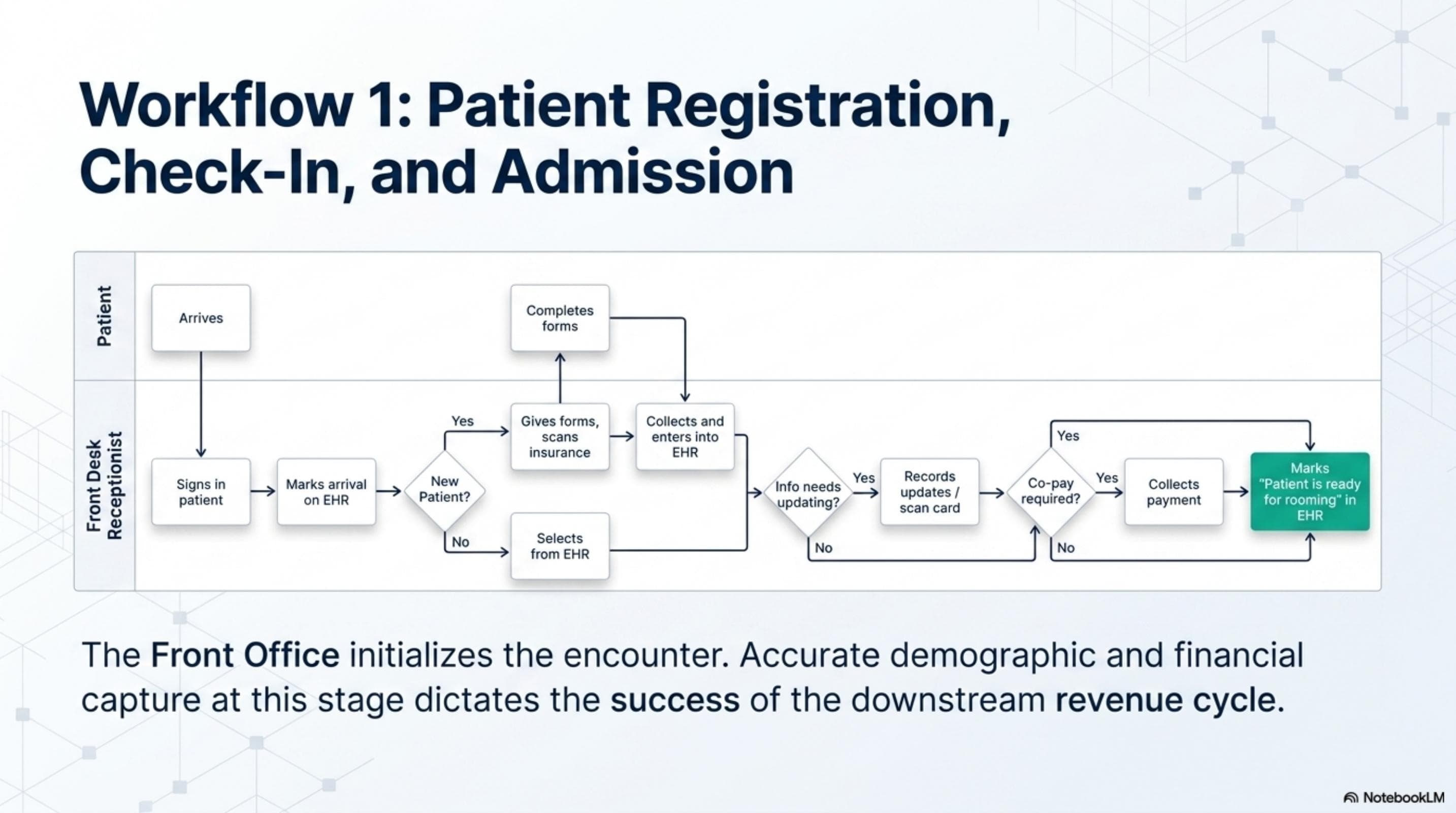
- Explain why most billing problems originate at the front desk
- Describe what happens to a claim after it leaves the practice
Presentation Slides
Review the slides below, then complete the reading and challenge.
Lesson Notes
Read through the key concepts before you try the challenge.
One visit, eleven steps
You are learning the workflow at a community clinic.
A patient is seen for twenty minutes. Clinically the encounter ends when they leave. Financially it has barely started — and if any one of the next several steps is done wrong, the practice performs the work and is never paid for it.
Your task: Learn the whole sequence, so you can tell where a problem actually started.
| # | Step | Zone | What goes wrong here |
|---|---|---|---|
| 1 | Scheduling | Front | Wrong visit type booked, so the wrong time is allotted |
| 2 | Pre-registration | Front | Demographics or insurance captured incorrectly |
| 3 | Eligibility verification | Front | Coverage lapsed and nobody checked |
| 4 | Prior authorization | Front | Required approval never obtained |
| 5 | Check-in | Front | Consent or copay not collected |
| 6 | Clinical encounter | Middle | Care delivered but not fully documented |
| 7 | Documentation | Middle | Note does not support what will be coded |
| 8 | Coding | Back | Code does not match the documentation |
| 9 | Charge entry and claim submission | Back | Claim rejected for a data error |
| 10 | Payer adjudication | Payer | Denial the practice must work |
| 11 | Payment posting and patient billing | Back | Balance never billed or never collected |
The revenue cycle is the same sequence viewed as money rather than as care. It is usually described in three phases: the front end (patient access — everything before and at check-in), the middle (health information management — documentation and coding), and the back end (patient financial services — claims, payments, denials, and collections).
The Patient Visit Lifecycle
Every healthcare encounter follows a predictable set of steps — from scheduling to discharge to payment. Understanding this flow is the foundation of working in any healthcare administrative role.
- Scheduling / Appointment Booking
- Pre-Registration & Insurance Verification
- Patient Check-In
- Clinical Encounter (exam, procedures, orders)
- Check-Out & Referrals
- Coding & Charge Capture
- Claim Submission
- Payment Posting & Denial Management
Why the Revenue Cycle Matters
The revenue cycle is how a healthcare organization gets paid for the services it provides. A single error at registration — a wrong insurance ID, a misspelled name — can delay or deny payment weeks later.
Challenge
Apply what you've learned in this lesson.
Which step comes immediately AFTER the clinical encounter in the patient workflow?
Finished this lesson?
Progress is saved in this browser only. It is not a grade — official progress lives in Brightspace.